Undisciplining Monsters and Monstrosity
Lesson Plan Production Details
Lesson Plan Description
This lesson plan enables students to examine power, classification, and technological control across colonial and postcolonial contexts by approaching monsters in Victorian and Nigerian literature as transhistorical cultural warnings that reflect imperialism and its afterlives.
In the lesson plan, students will study monsters in Victorian literature through H.G. Wells’ The Island of Dr Moreau and Robert Stevenson’s The Strange Case of Dr Jekyll and Hyde to see how the works form and reveal societal anxieties while critiquing the monstrosity of imperialism in nineteenth-century England.
The selection of texts also foregrounds two Nigerian texts, Nnedi Okoroafor’s novel The Book of Phoenix and her novella “Hello, Moto.” The former critiques the monstrosity of colonialism in the futuristic version of Nigeria. At the same time, the latter examines various notions of the “monstrous” and “the monster” as reflections of societal anxieties in the postcolonial and futuristic Nigerian worldview.
By engaging with monsters in Victorian and Nigerian literature, this lesson plan echoes the interest of Victorian Studies in “cataloging and classifying various forms of being” (Sukanya Bannerjee et al. 10) and in addressing related societal fears and anxieties.
The etymology of monster derives from the Latin monstrum and is related to the verbs monstrare (“show” or “reveal”) and monere (“warn” or “portend”). The etymology highlights the pre-occupation in Monster Studies to investigate monsters in different cultural and disciplinary contexts to interpret the warnings they symbolise and to gain understanding of the cultures in which they are produced (Guttzeit 5-6).
The lesson plan is recommended for a mid-level undergraduate class of about 10-15 students who are likely to be familiar with or interested in post-colonial theory and Victorian literature and monsters. The lesson plan is designed to fit any geographical classroom context. However, instructors are encouraged to identify student knowledge gaps such as historical contexts, particularly the backgrounds of Victorian and Nigerian society, to address such gaps accordingly.
This lesson plan also incorporates class discussion prompts and assignments that emphasize Writing Across Curriculum (WAC) strategies and that allow students to critically engage with generative artificial intelligence (AI), in line with the commitment of Undisciplining the Victorian Classroom (UVC) for the responsible use of AI technology.
Possible learning outcomes include students developing the ability to:
- engage with interdisciplinary theories of monstrosity;
- analyze monsters as cultural and political symbols of both Victorian and Nigerian literature; and
- critique the monstrosity of imperialism.
- critique the role of power systems in monstrosity
- develop critical writing and multimodal skills
Lesson Plan Texts
Primary Texts
H. G. Wells. The Island of Doctor Moreau. William Heinemann, 1896.
Summary
The novel follows Edward Prendick, an Englishman who arrives at a remote island in the Pacific where he meets Dr Moreau and his assistant Montgomery. There, Prendick learns that Moreau and Montgomery are exiled scientists involved in controversial vivisection experiments that focus on transforming animals into humanoids. Prendick discovers that the island is inhabited by these “grotesque” creatures and is being controlled by enforcing a set of rules to suppress the animalistic instincts of the humanoids. This fragile order, enforced through pain, is however, broken after the “Beast Folk” attack Montgomery and Moreau. Prendick flees the island but becomes paranoid and unable to re-integrate into human society.
Points for Analysis and Discussion
H.G. Wells’ The Island of Doctor Moreau offers a valuable subject for Monster Studies, as scholars can analyze the “Beast Folk” as monsters with a colonial undertone.
Students can study the relationship between the Beast Folk and the scientists as representing elements of colonialism. Moreau’s aim of transforming beasts into humans echoes this, hence justifying imperialism. Englishmen in the text describe the Beast Folk using attributes of monstrosity, which reveal the Victorian mindset of the colonized as the monstrous other.
The text assigns responsibilities and grants authority to the humanoid characters to carry out tasks for Moreau, thereby ensuring compliance with the law. The methods of enforcing rules among the Beast Folk and their resultant creation of a hierarchical structure among equals critique the indirect method of colonization implemented by the British.
Focusing on the “House of Pain”—the space where Dr Moreau carries out his vivisection experiments—and other threats of punishment towards the “Beast Folk”, this lesson plan studies the place of pain, fear, punishment and violence in suppressing resistance during the British colonial rule.
Pain and oppression are also connected to the principles of creating a slave as expounded by British slaver, Willie Lynch, in his treatise, The Making of a Slave. In addition to the frequent alternation between the Africans and the “beast,” the text encourages varying degrees of violence to break the Africans and ensure they do not resist oppression. Altogether, this text locates slavery as a part of colonialism and, in turn, colonialism as a form of slavery in West Africa.
Stevenson, Robert Louis. The Strange Case of Dr Jekyll and Mr Hyde. Everyman Paperback Classics, 1992.
Summary
Stevenson’s The Strange Case of Dr Jekyll and Mr Hyde tells the story of Dr Henry Jekyll, a scientist who seeks to separate his good side from his bad side. This desire leads him to develop a potion that creates Mr Edward Hyde, a violent and amoral version of himself who carries out his suppressed evil desires. Hyde grows stronger over time, and Jekyll loses the ability to reverse the transformation. At the end, Dr Jekyll confesses to being the same person as Mr Hyde, and he eventually dies, consumed by the evil he tries to suppress.
Points for Analysis and Discussion
In Stevenson’s The Strange Case of Dr Jekyll and Mr Hyde, students can focus on understanding nineteenth-century anxieties and social attitudes as depicted through the monster, Mr Hyde.
Students can study the descriptions of Mr Hyde and his accompanying actions, notably his physical description, which is mostly grotesque, and his actions, which are related to heinous crimes. These critiques notions of deformity and criminality as monstrosity.
Furthermore, students can examine the idea of the dual nature of good and evil in man as a critique of the bestial nature that the British Empire seeks to project as the sole nature of the colonized. The understanding of human duality and the propensity to slip into the bestial or degenerated state reveals the atavistic societal anxiety of the nineteenth-century Victorian period and how their view of the colonized as monsters is a projection of their fears.
Finally, students can also study the process through which monsters are created. The scientific experiments that led to the creation of monsters in The Island of Dr Moreau and The Strange Case of Dr Jekyll and Mr Hyde reflect a lack of morals and ethical boundaries. These experiments reveal the excesses and fears that the British had about science and technology in the nineteenth century and how such overindulgence could result in monstrous outcomes.
Okorafor, Nnedi. “Hello, Moto.” Reactor, 2 Nov. 2011.
Summary
Nnedi Okoroafor’s “Hello, Moto” is a novella that blends Africanfuturism and Africanjujuism due to the fact that technology and witchcraft combine to create the conflict of the plot. The short story centers on a group of three Nigerian women who use a wig created by witchcraft and technology to cause havoc in the society they had originally set out to liberate from corruption using the wig. The end of the story tells of the women transforming from “psychic” to “blood-sucking” vampires. This signals a heightened transformation into the monstrous.
Points for Analysis and Discussion
Discussing the genre of “Hello, Moto” can serve as a point for introducing an African perspective to the discussion of monsters and the monstrous.
Nnedi Okoroafor coined the terms “Africanfuturism” and “Africanjujuism”. The former defines a sub-genre of science fiction that centers on African experience, while the latter defines a sub-genre of fantasy that highlights African spirituality and cosmology in addition to other characteristic features of science fiction and fantasy.
Different from Mark Dery’s Afrofuturism, Africanfuturism centres on Africa and not the West. In her essay Africanfuturism Defined, Nnedi Okoroafor explains that “Africanfuturism is concerned with visions of the future, is interested in technology, leaves the earth, skews optimistic, is centred on and predominantly written by people of African descent (Black people), and is rooted first and foremost in Africa. Africanfuturism is less concerned with ‘what could have been’ and more concerned with ‘what is and can/will be.’ It acknowledges, grapples with and carries ‘what has been.’” Okoroafor also defines Africanjujuism as “a subcategory of fantasy that respectfully acknowledges the seamless blend of true existing African spiritualities and cosmologies with the imaginative.”
Concerning Monster Studies and Victorian literature, “Hello, Moto” offers an African perspective on anxieties about science and technology. Students can study the drastic shift from positive scientific endeavors to the creation of the monstrous. Students can compare “Hello, Moto” with Victorian texts mentioned above to explore similarities, such as the absence of morals and ethics in scientific research, and the atavistic degeneration and monstrous outcomes that result from the overindulgence of free will.
Students can also draw insights by analyzing the differences between the cultural contexts of the Victorian and Nigerian texts. Centering Nigerian spirituality can highlight differences in the process of the creation of the monstrous, and the outcome can extend beyond portraying the anxieties of science to include exposing greed as a vice culturally condemned. Furthermore, students can study how the social context highlights corruption as a monstrous issue, one that ultimately transforms the women who originally sought to fight against it into monsters themselves.
Okoroafor, Nnedi. The Book of Phoenix. Daw Books, 2015.
Summary
Okoroafor’s The Book of Phoenix follows the story of Phoenix Okore, a genetically enhanced human created and restrained by LifeGen Technologies in future America. Following the death of another “SpeciMen” like her and a series of unfortunate events, Phoenix escapes Tower 7, where she is held captive and goes on a journey across the globe, seeking truth, vengeance, and freedom. Using her superpowers, she becomes a revolutionary figure who resists oppression and causes change.
Points for Analysis and Discussion
For an introduction to the text, students can study the genre of Nnedi Okoroafor’s The Book of Phoenix. Alongside the definitions of Africanfuturism and Afrofuturism given by Nnedi Okoroafor and Mark Dery respectively (see above), students can critically evaluate where the Book of Phoenix falls within these categories and how it differs from other primary texts mentioned above. This allows students to comparatively analyze the features of Africanfuturism, Afrofuturism, Africanjujuism and Victorian Gothic.
Narrowing into Monster Studies, students can also examine the demography of the inmates at Tower 7, the body “accelerations” performed on the speciMen, and how the speciMen are regarded as both a threat and wonder in connection to themes like colonialism, objectification, scientific racism, and monstrosity. The inmates, mostly Africans, are imprisoned in the tower in New York, where scientists engineered extreme body modifications for destructive purposes through inhumane scientific procedures. Examining the brutal experiences of bodies marked with difference in The Book of Phoenix and other texts allows students to study the humanity of “monsters” and how these narratives encourage empathy towards bodies with differences instead of hate.
Students can also analyze the capturing, exploitation, and oppression of Phoenix, HeLa and other speciMen as a critique of the human exploitation that accompanied British colonialism, as in the case of Sarah Baartman. Sarah Baartman displayed as “Hottentot Venus”, exemplifies the case of exploitation and monsterization of the African female body through the freak shows and human zoos in nineteenth century Britain.
A member of the Xhosa ethnic group in South Africa, Baartman appeared in fairs and exhibitions owing to her protuberant posterior, which was a result of Steatopygia. Exhibitors forced her to perform in scanty clothing and endure sexual harassment while they collected payments from their audience.
Students can further connect the experimentations on the speciMens to the “scientific” research and experiments conducted on Sarah Baartman’s corpse. For example, after she died in 1815, her corpse was sent to George Cuvier, a European anatomist who made a plaster cast of her corpse and then dissected her body for his scientific research (Dzifa).
Students can also study how The Book of Phoenix reflects contemporary issues by connecting the realities of “SpeciMens”, such as being restrained and viewed as criminals, to the contemporary realities of migrant bodies in the West. They can examine immigration and border policies in terms of how they dehumanize migrants and act as forms of systemic monstrosity.
Also, students can study Nnedi Okoroafor’s The Book of Phoenix as a narrative of resistance to imperialism and oppression. They can discuss Phoenix’s acts of resistance as a symbolic undertone of her name and assess how her acts of resistance are also geared towards reclaiming her identity, centering Africa, while being destructive at the same time.
Supplemental Primary Texts
The supplemental primary texts provide additional materials for understanding how the colonial mentality works, which is central to this lesson plan.
Lugard, Frederick John Dealtry. “Introduction.” The Dual Mandate in British Tropical Africa. Edinburgh, London, W. Blackwood and Sons, 1922, pp.1-8.
This introduction by Frederick Lugard from the colonial era gives a contrast between Africa and the rest of the world in terms of civilization. Other regions are described as highly developed, while Africa is a “dark continent” shrouded in secrecy. The article emphasizes the continent’s isolation, gives reasons for the justification of its colonization, and explains the “civic” and “moral” duty of Britain towards the “dark” continent.
Lynch, William. The Willie Lynch Letter and The Making of a Slave. Lushena Books, 1999.
From a British slave master’s perspective, this text offers a systematic study of breaking Black people and making slaves out of them. It describes the rationale and methods considered effective for eradicating resistance from the oppressed and ensuring the master/slave relationship. Note: Critics debate the authenticity of this document. Instructors are encouraged to approach this document as a cultural artifact of racial ideology rather than a straightforward historical archive.
Supplemental and Secondary Texts
The supplemental and secondary materials provide a critical framework as well as social and historical background for understanding the issues raised in the primary texts above. To ease adoption, the following bibliography distinguishes between “core” and “optional” readings for students, and “background” readings for instructors.
Understanding Monsters and Monstrosity
Guttzeit, Gero. “Introduction.” Anglistik, Jan. 2019. Core (students).
This article provides an introduction to the concept of monsters and monstrosity. It delves into the diverse fields that contribute to understanding concepts such as cultural criticism, religion, literary studies and psychoanalysis. It examines the significance of monsters as a representation of societal fears, anxieties, and transgressions across historical, cultural, and literary contexts. The article traces the evolution of monstrosity from classical myths to contemporary texts and draws on the ideas of critics like Michel Foucault, Julia Kristeva, and Jeffrey Jerome Cohen to discuss monstrosity in relation to the abject, the Other, and power structures.
Cohen, Jeffrey. “Monster Culture (Seven Theses).” The Monster Theory Reader, University of Minnesota Press, 2020. Core (students).
Focuses on Jefferey Jerome Cohen’s theory of monsters and monstrosities. The essay seeks to understand cultures through the monsters they engender. Cohen offers seven theses which enable this study. They are: 1. The monster’s body is cultural, 2. the monster always escapes, 3. the monster is the harbinger of category crisis, 4. the monster dwells at the gates of difference, 5. the monster polices the borders of the possible, 6. the fear of the monster is really a kind of desire, and 7. the monster stands at the threshold of becoming. This article could be useful in helping students understand how monsters reflect the societal fears, desires, and anxieties in Victorian and Nigerian texts.
Corinner, Wargner. “Genealogies of Monstrosity: Darwin, the Biology of Crime and Nineteenth-Century British Gothic Literature.” The Cambridge History of the Gothic, vol. 2, Gothic in the Nineteenth Century, Cambridge University Press, 2020, pp. 416-44. Background (instructors).
Introduces the idea of monsters and monstrosities from a Darwinian biological perspective, materialism, and criminal anthropology. The article suggests that gothic monsters of the Victorian period are rooted in experimental surgeons creating grotesque beings, sadistic criminals driven by evolutionary determinism and carnivorous plants with animal-like anatomies. Darwin’s idea of the “Tree of Life” is also examined to show the regression of humans. The article is relevant for discussing the issues of technological anxiety, criminality, and atavism highlighted in the primary texts.
Erle, Sibylle, and Helen Hendry. “Monsters: Interdisciplinary Explorations in Monstrosity.” Palgrave Communications, vol. 6, no. 1, Mar. 2020, pp. 1-7. Optional (students).
Sibylle Erle and Helen Hendry’s article provides an interdisciplinary exploration of the concept of monsters and monstrosities by focusing on their cultural, literary, and social significance. With Mary Shelley’s Frankenstein as its primary text, the article examines the cultural significance of monsters and studies how Frankenstein serves as a cultural reference point to other interdisciplinary subjects. The article also studies the monster as a human identity influenced by the way it is perceived by others and projects a Foucauldian perspective of monsters and monstrosities.
Understanding Africanfuturism, Afrofuturism and Africanjujuism
Ainehi Edoro. “What Is Africanjujuism?” Brittle Paper, 7 July 2021. Core (students).
Introduces the concept of Africanjujuism coined by Nigerian American writer, Nnedi Okoroafor. It highlights the concept as a unique sub-genre of fantasy and argues that the concept seeks to capture the complexity of African life and cosmology, where there is a seamless blend between the supernatural and the natural.
Cleveland, Kimberly, and Ainehi Edoro-Glines. “Introduction: Afrofuturism and Africanfuturism: Same Difference?” Africanfuturism, Ohio University Press, 2024, pp. 1-18. Core (students).
Examines the difference between Afrofuturism and Africanfuturism. Drawing from Nnedi Okoroafor’s definitions, it expounds on the distinctions between both concepts and discusses their examples in film, literature, visual arts and music.
Monstrosity in Colonial Nigeria
Asaju, Olasunkanmi Victor, and Yahaya Yusuf. “British Colonial Punishments in Northern Nigeria: A Study of Native Authority Prison and Crime Control in Idah, 1929-1945.” Wukari International Studies Journal, vol. 7, no. 5, Dec. 2023, pp. 145-53. Optional (students).
Explores the contrast between precolonial and colonial methods of punishment in Idah district, Northern Nigeria. A key difference noted is the centrality of peace-building to the punishments approved by indigenous customs, while prisons and other criminal justice systems introduced by the British served as a means of sustaining colonial labor while enforcing asymmetrical power relations and social distancing in Idah society. This article can serve as a complement to the study of indirect rule as highlighted in the discussion of H.G. Wells’ The Island of Dr Moreau.
Peté, Stephen, and Annie Devenish. “Flogging, Fear and Food: Punishment and Race in Colonial Natal.” Journal of Southern African Studies, vol. 31, no. 1, 2005, pp. 3-21. Core (students).
Stephen and Devenish examine the form of punishments meted out to people in colonial Natal, South Africa. The study highlights flogging as a major form of corporal punishment, disproportionately applied to African subjects. This article alludes to ideas of colonial paternalism as well as the whites’ fear of the Black race. This article can also serve as suitable material for studying the punishments meted out to the “Beast Folk” in Wells’ The Island of Doctor Moreau as methods of suppressing resistance in colonial rule.
Pierce, Steven. “The Suffering Subject: Colonial Flogging in Northern Nigeria and a Humanitarian Public, 1904-1933.” Comparative Studies in Society and History, vol. 66, no. 2, Apr. 2024, pp. 319-41. Cambridge University Press. Background (instructors).
Examines flogging as a colonial punishment in northern Nigeria between 1904 and 1933. The flogging of women and educated Africans led to a series of controversies, which the article also analyses. The article argues that the Nigerian administration and the colonial office made light of the issue and adopted measures such as ensuring that flogging was carried out by Africans to “curb” the matter. This article can serve as material for studying indirect rule and the role of Africans in enabling white supremacy.
Nelarine Cornelius, et al. “British ‘Colonial Governmentality’: Slave, Forced and Waged Worker Policies in Colonial Nigeria, 1896-1930.” Management & Organizational History, vol. 14, no. 1, Oct. 2024, pp. 10-32. Optional (students).
Examines the colonial government in Nigeria by highlighting the relationship between the Foucauldian concept of “governmentality” and the combination of waged labor, indirect rule, and forced labor as a tool to break resistance and cause cultural disruption in colonial Nigeria. The article emphasizes how these combined strategies. In addition to brutal force, they are used to exploit labor and the region’s resources for industrial growth. This article can also serve to supplement the discussion of indirect government and pain as tools for enforcing oppression.
Monsters and Monstrosity in Contemporary Times
Tyerman, Thom, and Travis van Isacker. “‘Here There Be Monsters’: Confronting the (Post)Coloniality of Britain’s Borders.” Review of International Studies, Nov. 2024, pp. 1-21. Core (students).
Connects the view of monstrosity as “animalization, zombification, criminalization, and barbarization” prevalent in the colonial era to the contemporary treatment of migrants in Britain. The article introduces the image of a headless, tentacled Leviathan to represent the dispersed and far-reaching nature of border enforcement. The article is relevant in examining the continuity of the image of the colonized monsters even after the “end” of imperialism in general politics, border policies, and the treatment of migrants in the UK.
Johnson, Sylvester. “Monstrosity, Colonialism, and the Racial State.” J19: The Journal of Nineteenth-Century Americanists, vol. 3, no. 1, 2015, pp. 173-81. Core (students).
Examines monstrosity as political and as rooted in racist and imperial ideologies. Johnson argues that monstrosity is a political construct that was forged to maintain white supremacy. He further suggests that historical accounts of monstrous races were fabricated, and he highlights the scientific racism championed by Carolus Linnaeus and Thomas Jefferson. The article also traces the continuities of this dehumanizing ideology in contemporary issues of race and state violence.
Gender, Monsters and Monstrosity
Dzifa Benson. “Sarah Baartman, The Monsterisation of the Black Female Body and Its Poetics.” Dzifa Benson, N.d. Core (students).
Discusses the extremity of colonialism and racism in the life and death of Sarah Baartman. Highlights scientific racism, objectification and the monsterization of Sarah Baartman because of her physical “differences.”
Hunt-Kennedy, Stefanie. “Imagining Africa, Inheriting Monstrosity: Gender, Blackness, and Capitalism in the Early Atlantic World.” Between Fitness and Death: Disability and Slavery in the Caribbean, edited by Stefanie Hunt-Kennedy, Online Edition, University of Illinois Press, 2020, pp. 13-38. Core (students).
Focuses on how Africans are thought of as monstrous physically and morally by Europeans, hence justifying imperialism and slavery. The article also discusses the imagination of Africa as a geographical space perceived as a space of horror, with blackness as a curse, and with African women as hyper-sexual, deformed, and bestial.
Crais, Clifton, and Pamela Scully. Sara Baartman and the Hottentot Venus: A Ghost Story and a Biography. Princeton University Press, 2009. Background (instructors).
A biography of Sarah Baartman that accounts for the complexity of her history as shaped by different cultural settings. In an attempt to reclaim her identity, the book foregrounds the South African frontier and its genocidal violence, cosmopolitan Cape Town, the ending of the slave trade, the Industrial Revolution, the French Revolution, the Napoleonic Wars, London and Parisian high society, and the rise of racial science. It examines how the concept of the Hottentot Venus persists in contemporary representations of women, race, and sexuality.
Class Activities and Discussion Questions
The class activities for this lesson plan are categorized as formal and informal. The formal activities consist of high-stakes assignments that go beyond evaluating students’ understanding of the subject to include assessing how the subject matter has been received. By contrast, informal activities consist of “low-stakes” writing tasks that allow students to internalize the concepts taught in class without emphasis on their grade.
This lesson plan proceeds on the basis that informal writing tasks help students understand the subject and eliminate the anxiety that often accompanies writing by easing the students into finding their voice. The process eventually enables the students to perform well in the higher-stakes activities (Elbow 8-10). The informal activities also reduce the chances of using AI to generate answers to writing assignments. The informal writing activities can be done in class, after which students can share their thoughts in an online discussion forum where students can engage in each other’s contributions, while the formal activities can be assigned later and submitted on a stipulated date.
Also, both categories of activities capitalize on writing as a tool for internalizing the taught subject matter, getting students to engage with the subject and familiarizing them with the discourse conventions of the literary discipline. This approach allows students to develop critical thinking and writing skills as it employs strategies of the Writing Across Curriculum program of development (“What is a WAC Program?”).
Below are some samples of writing tasks and discussion prompts.
Informal Activities
Warm-Up Meta-Cognitive Reflection
Objective(s): Activate prior knowledge about monsters, introduce students to themes surrounding monsters, and foster critical engagement.
Informal Writing/Class Discussion Prompt: Think about any monster you might have encountered through a book, movie, folktale, or in reality. What characterizes the monster as a monster? Is it its appearance, behavior, origin, or the way others treated it? If it were some sort of written or visual narrative, does the narrative say anything about the fears of the monster’s originating culture or community?"
Genre Framing
Objective(s): Develop a working understanding of genre to frame how texts explore monstrosity through culturally distinct lenses.
Informal Writing/Class Discussion Prompt:
- Complete a comparative genre feature grid that highlights elements of Afrofuturism, Africanfuturism, Africanjujuism, and Victorian Gothic using the following markers:
- Setting and geography
- Specific societal/cultural anxiety
- Presence of spiritual/supernatural elements
- Relationship to colonial/postcolonial history
- Representation of monstrosity
- Under which category of genre can each text studied in this lesson plan be grouped?
- How do genre conventions affect the creation and interpretation of the “monstrous”?
Pain and Terror in Colonial Rule
Objective(s): Examine the “House of Pain” as an allegory of the place of pain, fear, punishment, and violence in British colonial rule.
Informal Writing/Class Discussion Prompt:
Write down your thoughts on the following questions:
- How do pain, punishment, and fear act as a colonial tool in The Island of Dr Moreau and The Making of a Slave?
- How does the British Empire use the body to control the mind of the oppressed individual in The Island of Dr Moreau and the Making of the Slaves?
- How do the Beast Folk describe or react to punishment? What language reflects their internalized terror?
Criminality, Difference and Monstrosity
Objective(s): Examine how criminality and difference encode monstrosity in Victorian literature
Informal Writing/Class Discussion Prompt:
Write down your thoughts on the following questions:
- What physical descriptions and actions of Mr Hyde suggest monstrosity?
- How do criminality, differences, and disability intersect in Victorian understanding of monstrosity?
Gender, Scientific Racism and the Humanity of “Monstrous Beings”
Objective(s): Expand on the theme of the monsterization of the African body and connect speculative fiction to colonial history
Informal Writing/Class Discussion:
Write down your thoughts on the following questions:
- How are the accelerated bodies of the Specimen in The Book of Phoenix and the case of Sarah Bartmaan simultaneously viewed as dangerous and desirable? How does this reflect racist ideologies and the monsterization of the female body?
- How does Okoroafor reframe the “monster” not as a threat to be eradicated, but as a victim of systemic oppression?
Reclaiming the African Identity
Objective(s): Examine how the text frames resistance to oppression, colonialism, and dehumanization of African bodies
Informal Writing/Class Discussion Prompt: Discuss Phoenix as a symbol of rebirth and resistance. How does her transformation from a compliant subject to a revolutionary figure illustrate this symbol?. How does the symbol mirror African resistance to colonial domination and the reclamation of indigenous identities erased by imperialism?
Formal Activities
Monstrosity and Colonialism
Objective(s): Analyze the colonial ideologies reflected through the relationship between the Beast Folk and the scientists in The Island of Dr Moreau, reflect the limitations of AI in generating answers to literary analysis, and encourage students to engage in close reading of texts.
Formal Activity: Highlight and compare specific descriptions of the Beast Folk in The Island of Dr Moreau and the Negro slaves by Englishmen in Willie Lynch’s, The Making of a Slave. Discuss how the descriptions echo ideologies of white supremacy and monstrosity. Next, using any generative AI platform, carry out the same writing task and compare the results of the two outputs.
Informal and Formal Activities
Indirect Rule and Colonial Power Structures
Objective(s): Examine law enforcement and power structures among the Beast Folk in connection to how they reflect Indirect rule in colonies like Nigeria.
Informal Writing/Class Discussion Prompt:
Write down your thoughts on the following questions:
- How does monstrosity play out in the enforcement of indirect rule by Moreau upon the Beast Folk and in the British colony
- What are the distinguishing qualities of the Beast Folk in authority? Who gives them this authority, and how is it sustained?
- What’s the Beast Folk’s perception of “The Law” and the Lawgiver? Compare this to the British colony.
Formal Writing: Compare the power structures on the island to any historical example of British indirect rule. Consider how authority is assumed in the colony by the “superior” people; how continuity, power and suppression of resistance frame the formation of these administrative structures; and the implications of creating internal elites within a colonized society.
Monstrosity, Duality, and Colonial Projection
Objective(s): Examine duality as a metaphor for Victorian anxieties about civilization and savagery, critique monstrosity as a colonial projection, and explore the Victorian fear of atavism or degeneration.
Informal Writing/Class Discussion Prompt:
Write down your thoughts on the following questions:
- What does Jekyll fear about Hyde?
- Why does Prendick fear ordinary people after Moreau’s Island?
- How do these fears reflect Victorian anxieties about race, empire, and the collapse of order/degeneration?
Informal Activity:
Create a Venn diagram comparing the attributes of the following characters and places:
- Hyde vs. Beast Folk
- Jekyll vs. Moreau
- London vs. the Island
Label attributes such as duality, violence, repression, projection, civilization/savagery, and control/punishment. The result of this exercise would show the similarities and differences of each item.
Formal Activity: In both The Strange Case of Dr Jekyll and Mr Hyde and The Island of Doctor Moreau, monstrosity seems to reflect not the colonized other, but the repressed or feared aspects of the self. How do these texts critique British imperialist ideologies through their portrayal of degeneration, duality, and fear? Think about how characters and narrators reflect the Empire’s fear of its moral decay.
Science, Ethical Boundaries and the Making of Monsters in Cultural Contexts
Objective(s): Examine how scientific experimentation in Victorian fiction reflects social anxieties about unchecked technological progress and moral decay.
Formal Activity
Write an essay concerning the following questions:
- How do Wells, Stevenson, and Okoroafor depict scientific overreach as monstrous?
- What ethical lines are crossed, and what consequences do these narratives warn us about?
- In what ways might these be allegories for societal anxieties and imperial or industrial projects of the time?
Informal Writing/Class Discussion Prompt
Write down your thoughts on the following questions:
- What unique perspectives do the concepts of Africanfuturism and Africanjujuism contribute to the understanding of monsters and monstrosities as symbols of societal fear and anxiety?
- In what ways does “Hello, Moto” suggest that monstrosity is a consequence of violating communal values and not just scientific ethics? In comparison to the Victorian fear of atavism or degeneration, how are the root causes and consequences of monstrosity in both societal contexts different and similar?
Final Projects
- Empathy Gram: Using either The Island of Dr Moreau or The Book of Phoenix, draw an empathy gram that illustrates the emotions of different “monster” characters in the text throughout the chapters. The empathy gram is a diagram that maps the network of emotions, perspectives and experiences of “monster” characters in the texts. From the students’ understanding of their chosen texts, they are expected to use diagramming tools like Lucidchart or draw.io to visualise a network of how these “monster” characters perceive the world around them. Questions to consider can include:
- What does the monster character see?
- What is done to them?
- What do they feel (emotionally and physically)?
- What are they labelled as by other characters or society?
The map can be drawn according to chapters. It is also advised that this project be introduced at the beginning of the class to enable students to draw the map as they read the texts for other class activities.
- Final Portfolio: Collate all writing tasks done during the class and write a reflective personal introduction that:
- Explains how the given student’s understanding of monstrosity evolved over the course.
- Identifies key themes that stood out to them (e.g., colonialism, body modification, hybridity, resistance); and
- Describes which activities or texts had the greatest impact and why.
Optionally, students can choose a creative introduction such as a poem, short story, digital collage, comic strip, or other creative or multimodal work exploring monstrosity, hybridity, or identity.
Acknowledgments
I appreciate: Prof. Adrian Wisnicki, my supervisor, for his steady guidance in helping me produce more grounded research; Prof. Mathias Iroro Orhero, whose peer review sharpened the rough edges and strengthened the clarity of the work; and Prof. Laura White, Darlington Anuonye, and Ugwuanyi Leonard, who listened, read, and offered unwavering support at various stages of the research.
Works Cited
Banerjee, Sukanya, et al. “Introduction: Widening the Nineteenth Century.” Victorian Literature and Culture, vol. 49, no. 1, Apr. 2021, pp. 1-26.
Dzifa Benson. “Sarah Baartman, The Monsterisation of the Black Female Body and Its Poetics.” Dzifa Benson, N.d.
Elbow, Peter. “High Stakes and Low Stakes in Assigning and Responding to Writing.” New Directions for Teaching and Learning, vol. 1997, no. 69, 1997, pp. 5-13.
Guttzeit, Gero. “‘Introduction’ to Monsters and Monstrosity in 19th-Century Anglophone Literature.” Anglistik, Jan. 2019.
Lynch, William. The Willie Lynch Letter and The Making of a Slave. Lushena Books, 1999.
Okoroafor, Nnedi. “Africanfuturism Defined.” Nnedi’s Wahala Zone Blog, 2019.
“What Is a WAC Program?” The WAC Clearinghouse, 1997.
Developer Biography
Cynthia Mbagwu is a master’s student in English with a specialization in Literary and Cultural Studies at the University of Nebraska-Lincon. She completed her B.A. in English and Literary Studies at the University of Nigeria, Nsukka. Cynthia's research interests include African fantasy, young adult fiction, digital archiving, and cultural heritage preservation. She is also a research assistant at The Walt Whitman Archive.
Tile/Header Image Caption
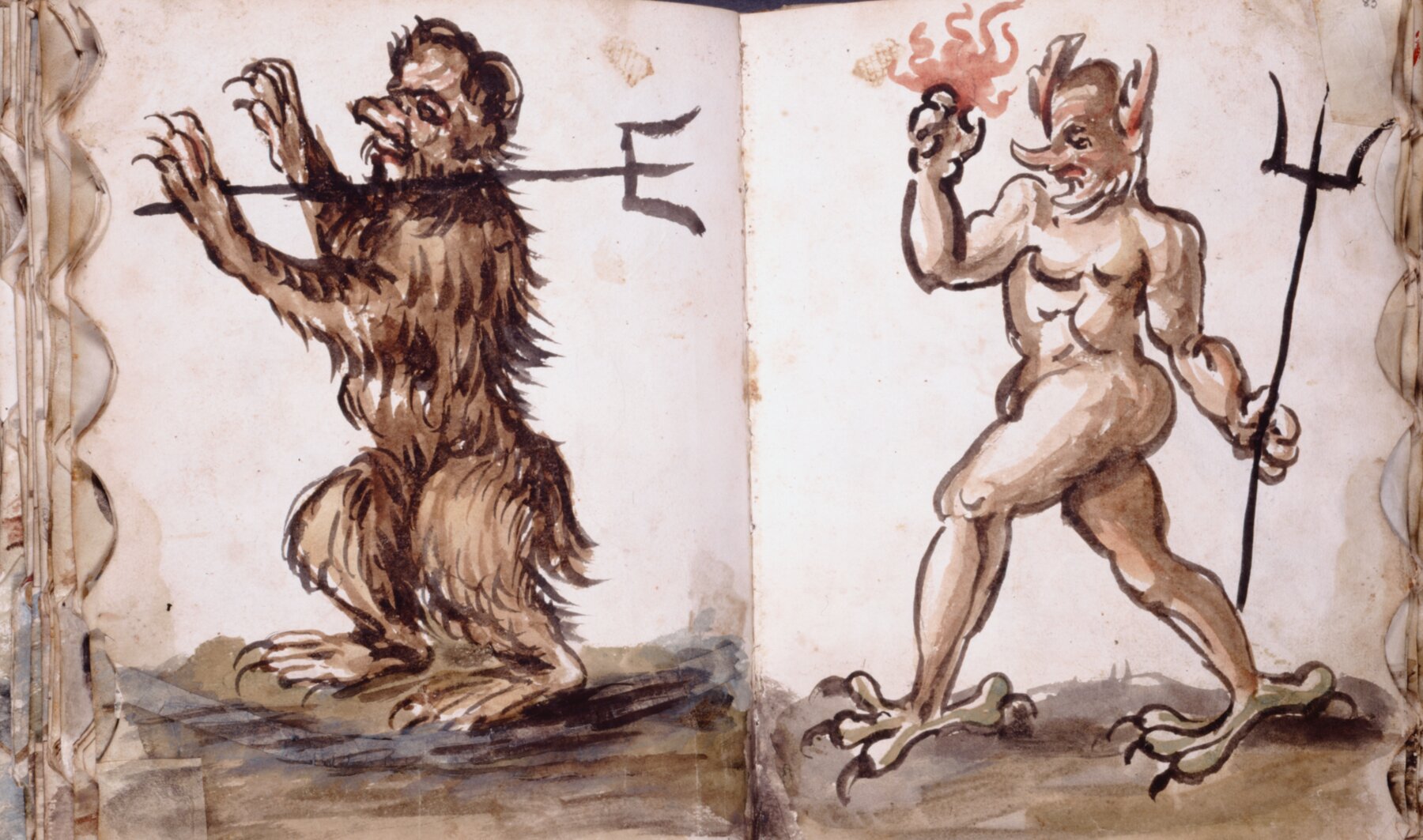
Once Known Artist. “Monster and Devil, ff. 82v-83.” Watercolor drawing. 1569-1591, NYPL Digital Collections, Spencer Collection. From The New York Public Library. The New York Public Library believes that this item is in the public domain under the laws of the United States, but did not make a determination as to its copyright status under the copyright laws of other countries. This item may not be in the public domain under the laws of other countries.
Page/Lesson Plan Citation (MLA)
Cynthia Mbagwu, dev. “Undisciplining Monsters and Monstrosity.” Mathias Iroro Orhero, peer rev.; Adrian S. Wisnicki, les. plan guide. Undisciplining the Victorian Classroom, 2026, https://undiscipliningvc.org/html/lesson_plans/undiscipling_monsters_monstrosity.html.